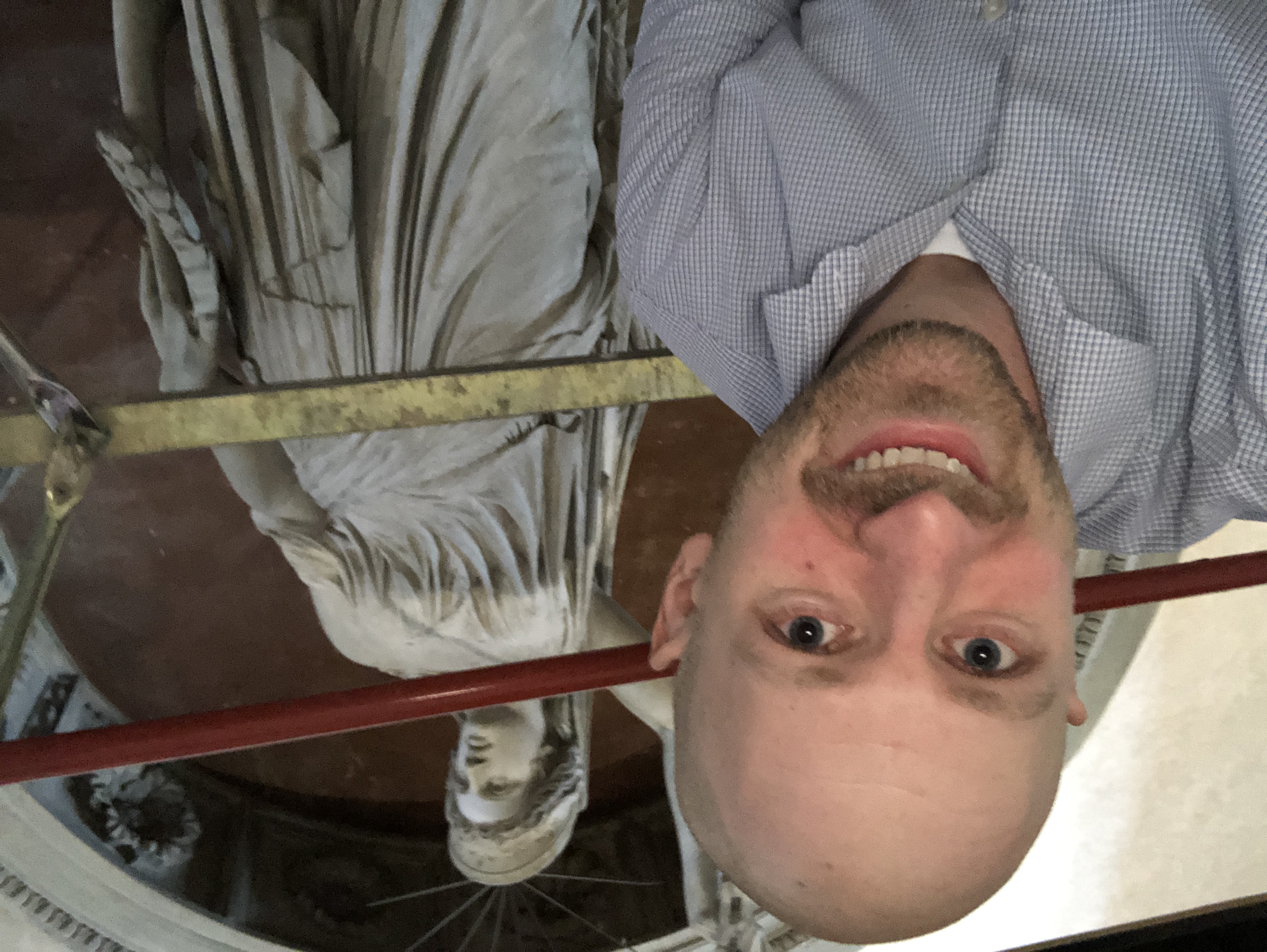
Joshua Allen Talbott
Digital artist: 3D capture, alignment, and fabrication planning
Pio Fedi's Liberty of Poetry could not leave Santa Croce, so she had to travel as data. My part of Libertas was that path: from the marble in Florence to a model that could be printed, cast, and shipped to New York.
I came to it from my role in IT and security at the college, but I took it on as a maker. I planned and led the 3D capture in Florence — the rig, the practice, and more than a hundred passes over the statue. Back home, I aligned those scans into a single mesh and rebuilt the crown's rays in Fusion 360 where the scan data ran out.
I ran the sightline, scale, and weight studies that set her at 80% and kept her safe on the museum's second floor. I evaluated every way we could manufacture her, and went to Youngstown to see Freshmade 3D's work in person before we greenlit it. Then I coordinated fabrication and finishing with the people named in the credits. I also built the project's website and supported the poetry kiosks: David Hassler and the Wick Poetry Center created the poetry experience, and the marketing firm Each and Every designed the kiosks.
This was never a one-person accomplishment, and the credits at the end name the people whose skills made the object real. But collaboration doesn't make individual contributions disappear. This page documents mine.
Led
- The 3D capture in Florence: the rig, the practice, and 100+ passes
Did myself
- Aligning the scans into one mesh
- Modeling the crown's rays in Fusion 360
- The sightline, scale, and weight studies
- Evaluating every manufacturing method, including a visit to Freshmade 3D in Youngstown
With the team
- Taking the rays through casting
- Spreader plates to keep her weight within the floor's limit
- Coordinating fabrication and finishing
Built and supported
- The project website on AWS
- Support for the poetry kiosks, designed by Each and Every, with the Wick Poetry Center experience from David Hassler's team
Kent State's own account of the project, in Kent State Magazine, names Robert Clements and me as the two 3D-imaging specialists the Design Innovation Initiative sent to Florence.
IThe spark
A dean who collected impossible ideas.
It started as a standing promise. In meetings, Dean Jim Blank would say that one day the college would take on something genuinely crazy — the kind of project that doesn't fit on a budget line. That appetite for ambitious, interdisciplinary work was part of the momentum that helped carry Kent State toward R1 research status.
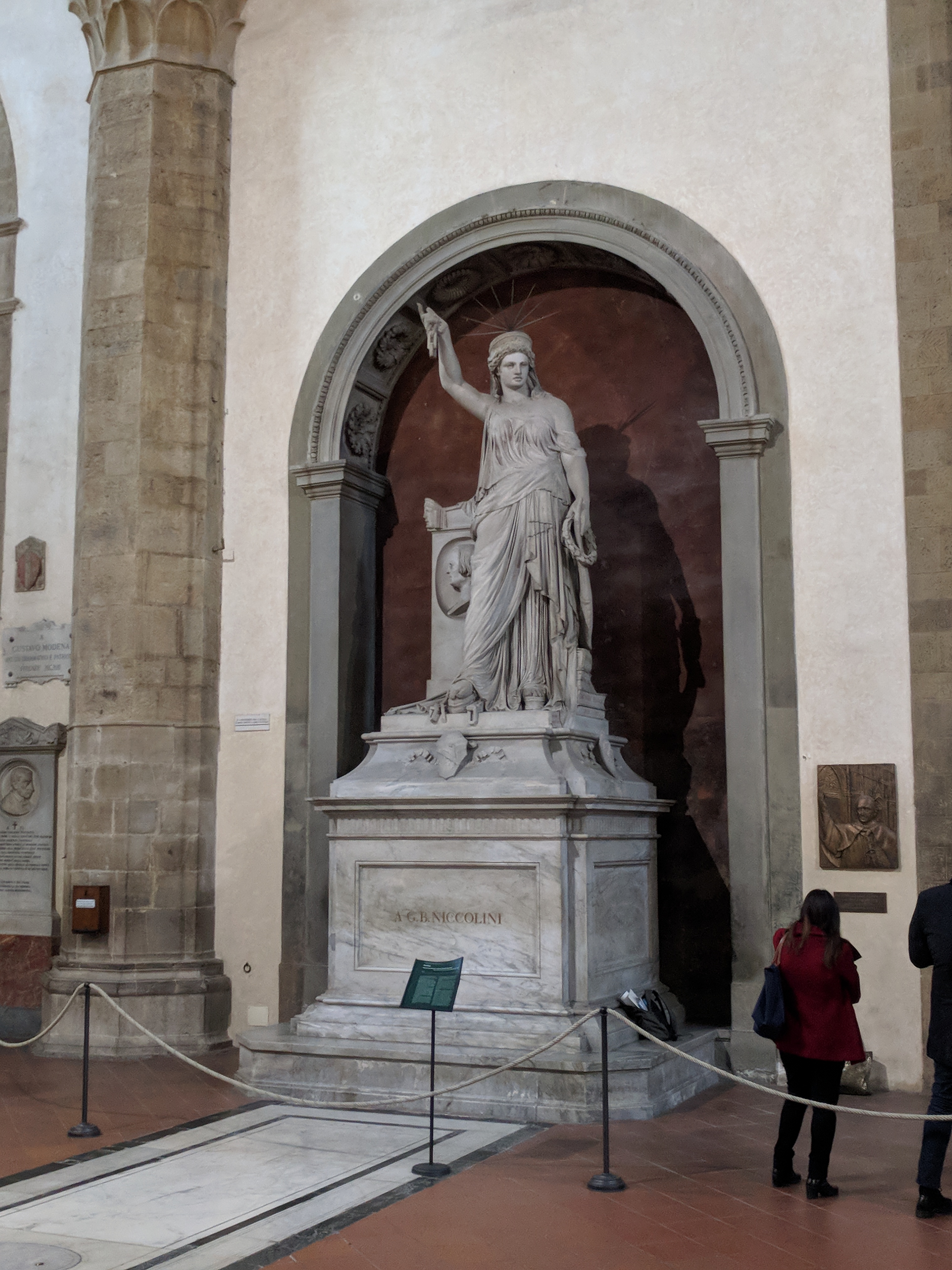
When the idea finally arrived, it was a statue: Pio Fedi's Liberty of Poetry, carved in the 1870s for the monument to the poet and playwright Giovanni Battista Niccolini in Florence's Basilica of Santa Croce, unveiled in 1883, and long speculated to have inspired Bartholdi's Statue of Liberty, dedicated in New York three years later. The Opera di Santa Croce wanted to show the two sisters together at Ellis Island, but the original could not leave the basilica.
So the plan was to scan her the way the David had been digitized — then bring her to New York not as a file, but as an object you could stand in front of. The question was no longer whether it could be imagined. It was who would actually make it.
IIThe brief
Every constraint was a decision about meaning.
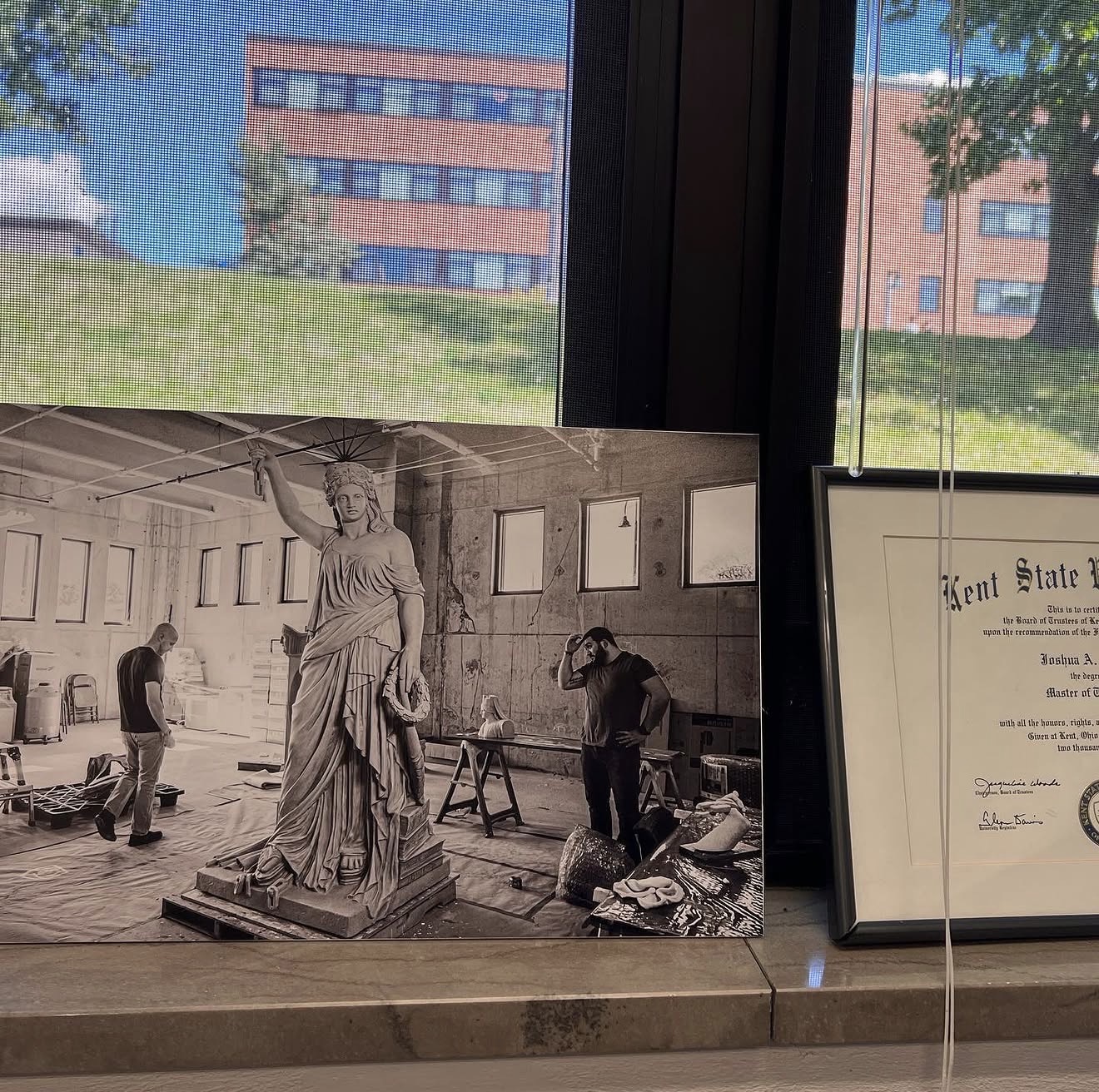
I evaluated every way we could make her. Foam — the way theater builds its props — was out early; up close it never reads as marble. A farm of cheap plastic FDM printers wouldn't hold together at the scale required. The answer was binder jetting: sand bound with adhesive, building marble-like mass and surface layer by layer. Freshmade 3D's work was impressive enough that I went to Youngstown to see it in person before we greenlit it.
The scale came from my model of the room. At 80%, she would hold the end of the exhibit hall exactly — full presence, never cropped by the sightline. I also ran the size and weight study, because she'd stand on the museum's second floor, where weight was a ceiling, not a detail. She had to be heavy enough to feel significant and light enough to stay within the floor's load limit.
We didn't want her lightweight and insignificant. Insignificant reads as cheap.
IIIFlorence
A scanner on a monopod, held out over a priceless statue.
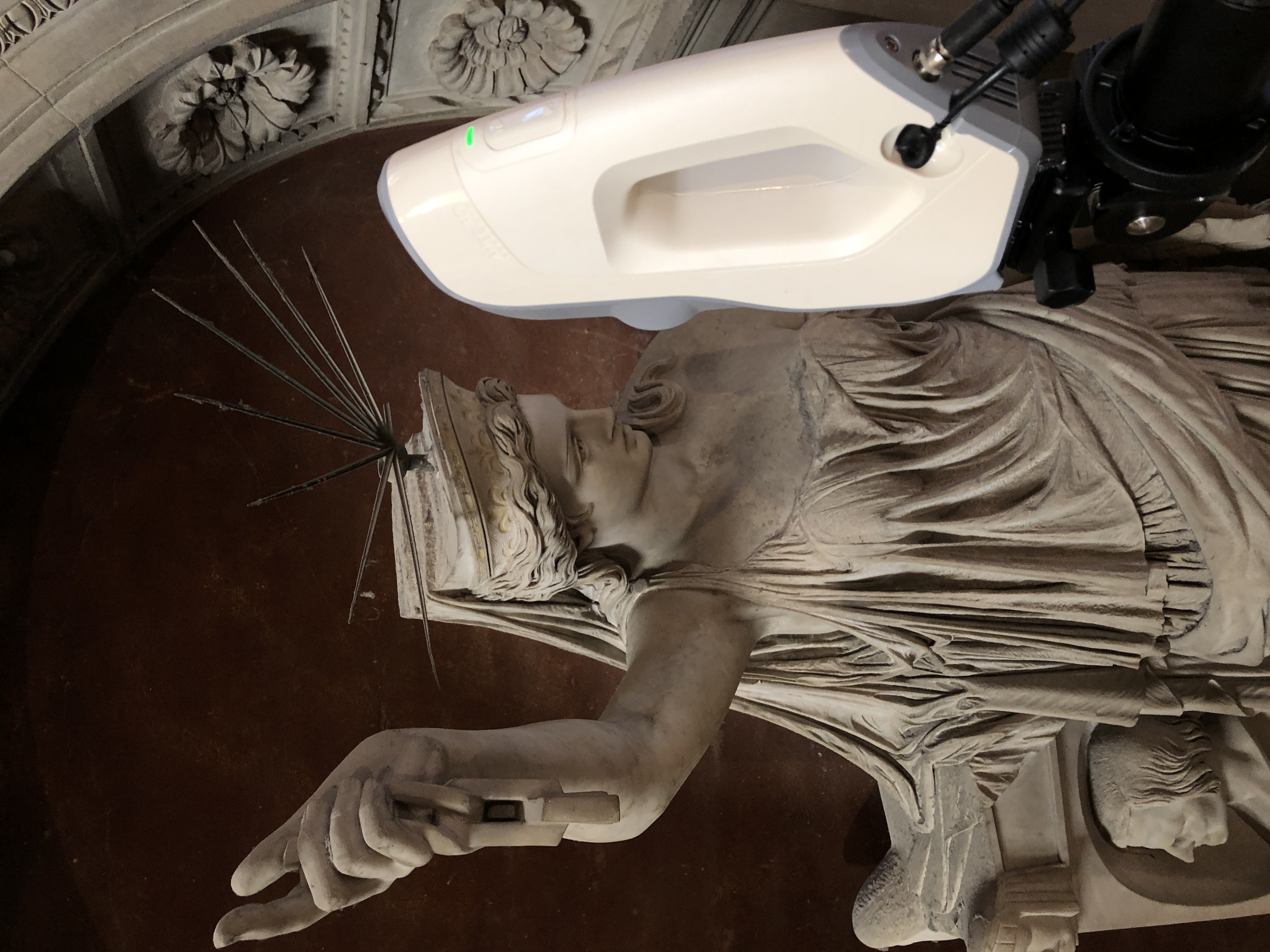
The capture rig was deliberately simple and deliberately practiced: an Artec Eva on a long carbon-fiber monopod, with an iPad carried alongside for live feedback on every pass. Over 100 scans built up the full figure — and not just one. The Libertas were a group, and the work honored the whole of them, the plural that became singular on its way to America.
Access was its own project. Before a hand could touch the work, there was insurance, a notary, and an Italian tax ID obtained in person at a government office. The permissions and logistics required to make the work possible were substantial. And the work happened steps from Dante's cenotaph in Santa Croce.
I planned that moment in my head for weeks — holding a scanner out over a priceless statue on the end of a pole — before we ever landed.
IVThe digital sculpt
One enormous mesh, and the artistry of cleaning it up.
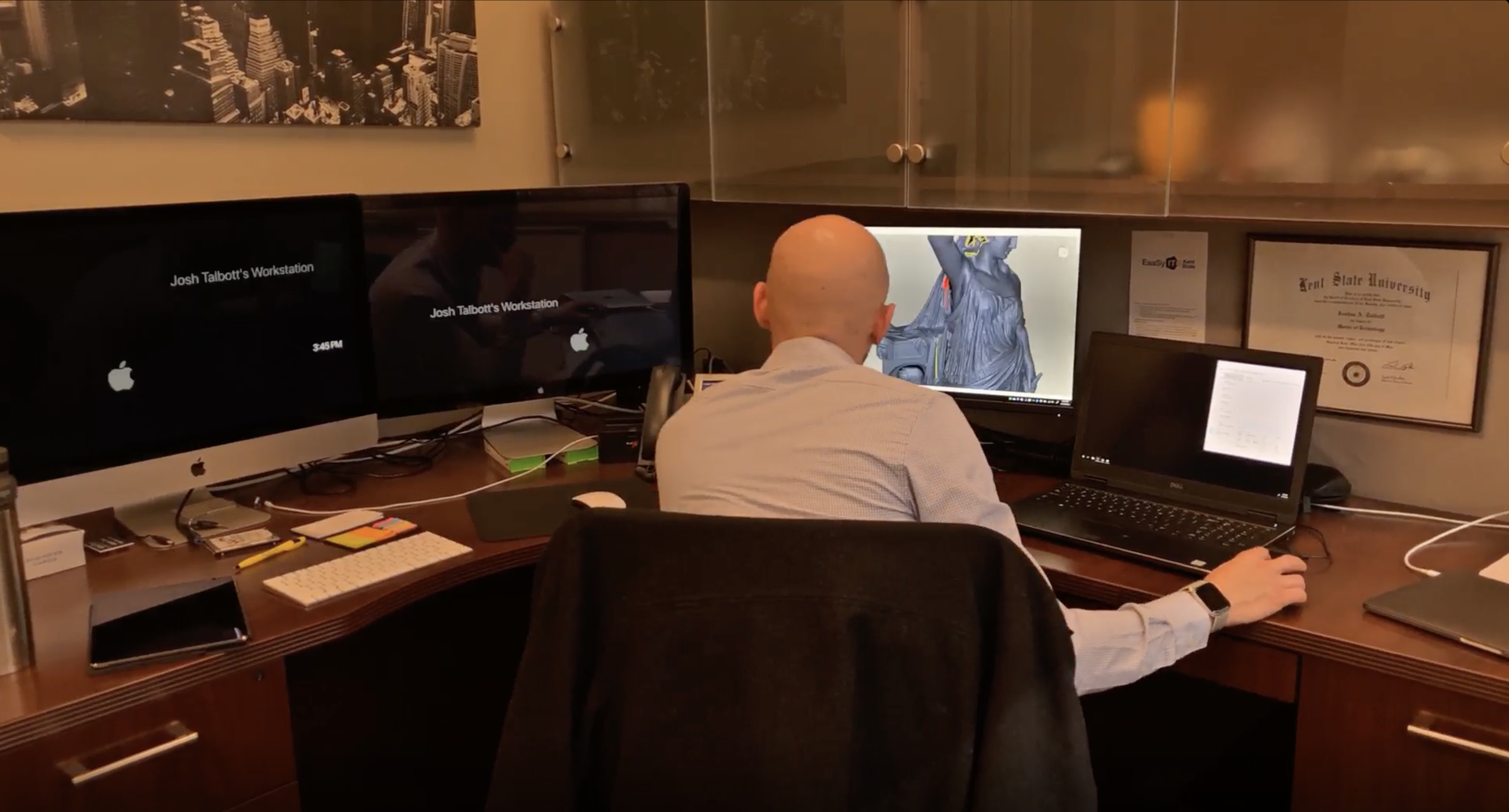
A hundred-plus scans don't align themselves. I aligned them into a single, unwieldy mesh with seams and overlap artifacts — flaws that would have printed faithfully if no one caught them. A 3D animation artist then did the fine, patient cleanup that only that craft really teaches.
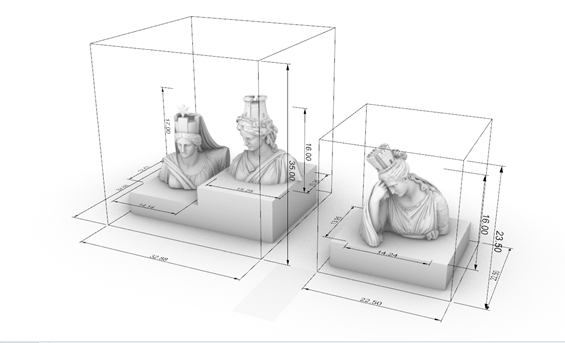
In parallel, Brendan Ho, a faculty member in the School of Architecture, modeled the exhibit cases and companion prints in Rhino, so the entire show could be seen and approved before anything was committed to print.
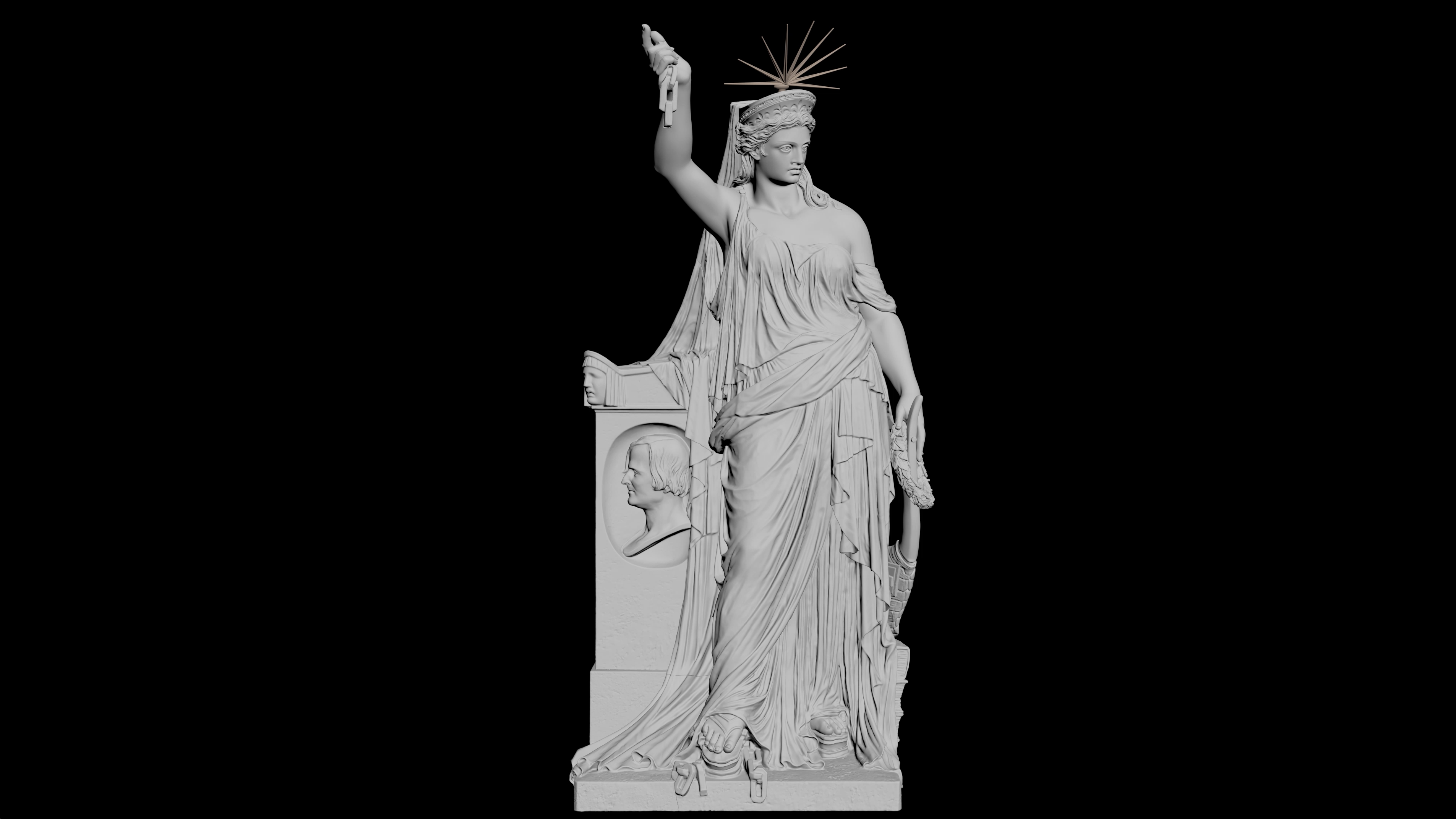
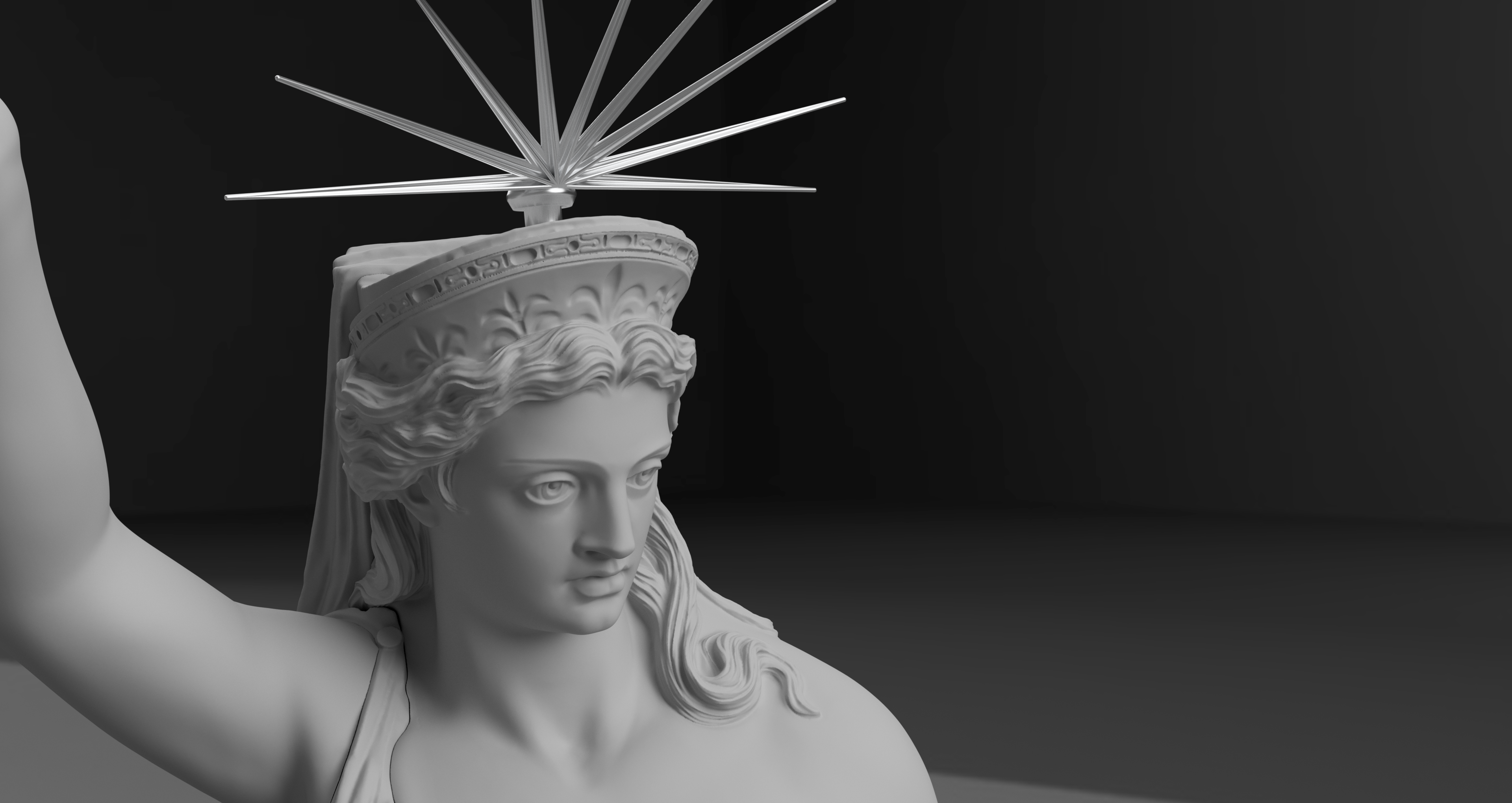
The crown's rays were the catch. There wasn't enough scan data to reconstruct them — only enough to measure them, tip to tip. So I rebuilt them by hand in Fusion 360 from reference photos taken on site.
VThe rays
Cast in aluminum. Two flawed pours, one finished crown.
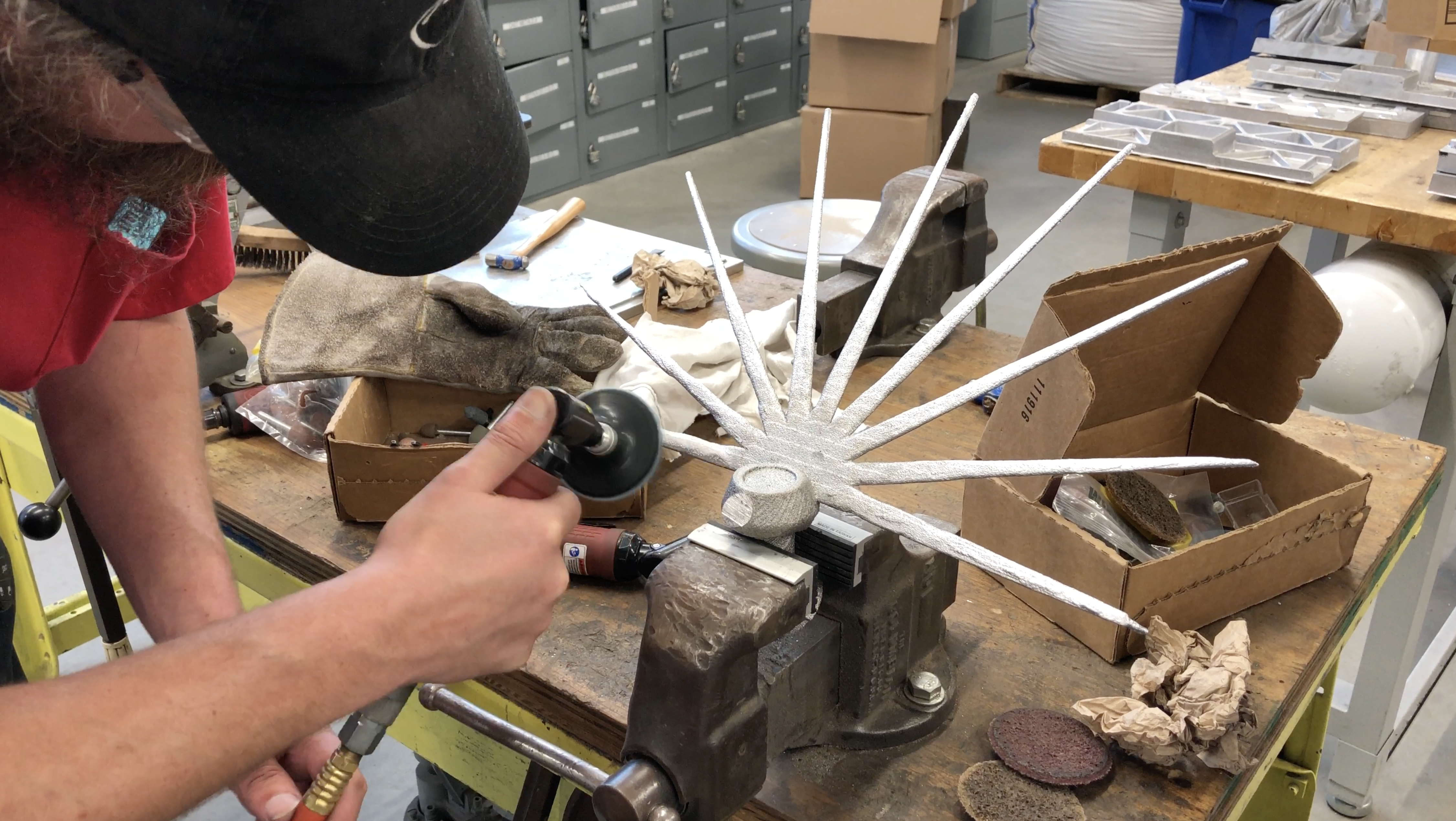
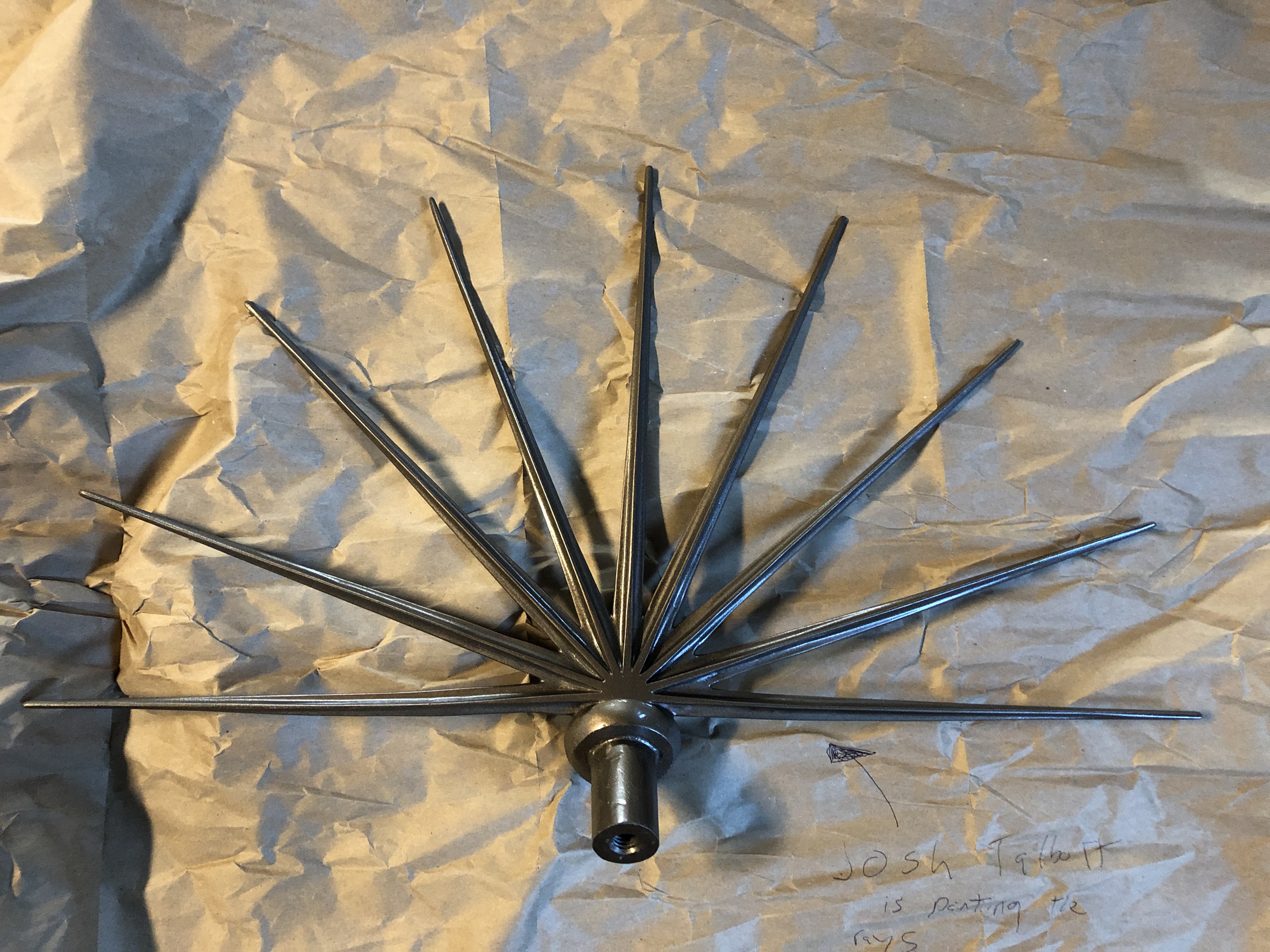
My Fusion 360 rays became a casting pattern, developed with Trent True in aeronautics engineering, and poured in aluminum at Kent State's College of Aeronautics and Engineering. Two sets were cast the same day. Both came out flawed — in different ways — so the team built one good crown from two bad pours.
Students welded the aluminum, and the welds and rays were polished to a shine in the physics machine shop with Jay Onders. Then the polished metal was painted to read as bronze. When a mounting hole came out slightly off, Tammy Honesty quietly corrected it.
Two bad casts. One good set of rays. That's the whole project in miniature.
VISand to stone
We didn't take her off a mountain. We grew her.
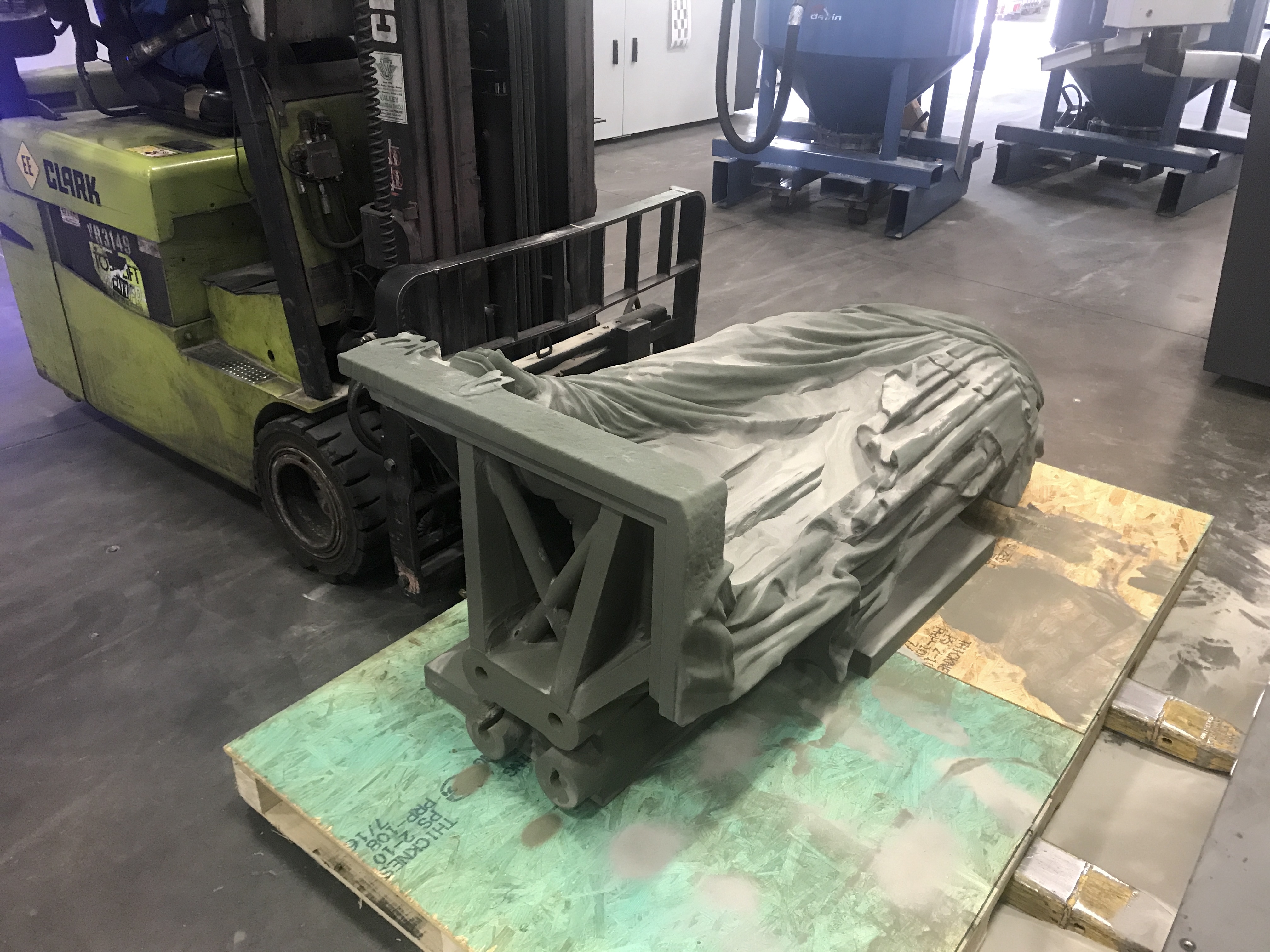
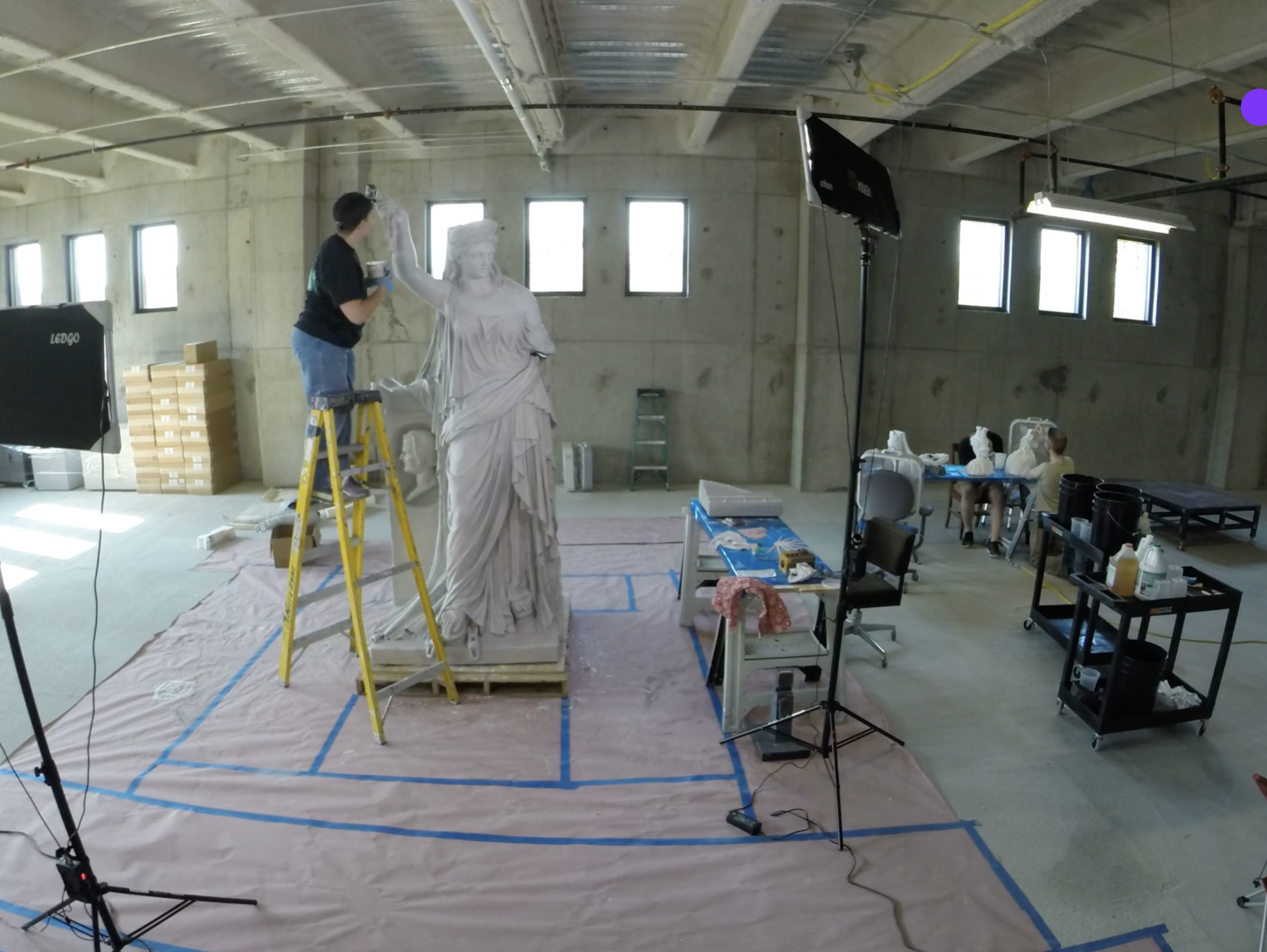
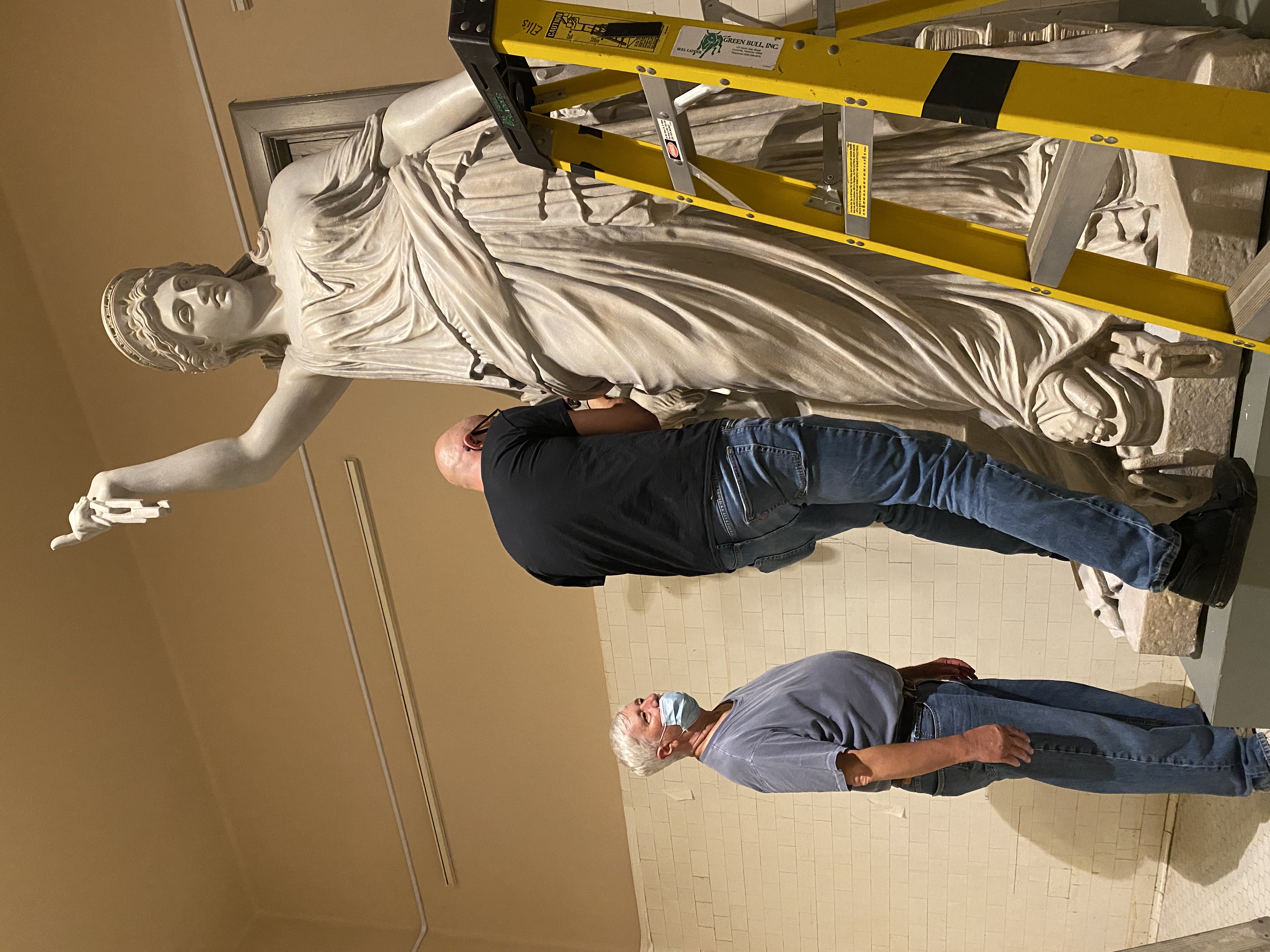
The figure was printed by Freshmade 3D / Humtown in Youngstown, Ohio. Binder jetting laid down sand and adhesive in thin layers, building a body with marble's weight and grain. Walking the shop floor mid-print and finding Liberty's arm already taking shape was its own kind of awe.
There's an argument inside the material. A traditional marble figure is carved from a quarried mountain. This one was built from sand and binder — abundant, and far gentler on the world. Then it was primed and finished, with Tammy's team painting test pieces before ever committing to the full statue.
Sand and glue, behaving like marble.
VIIThe plinth
A stand built to outlast the statue.
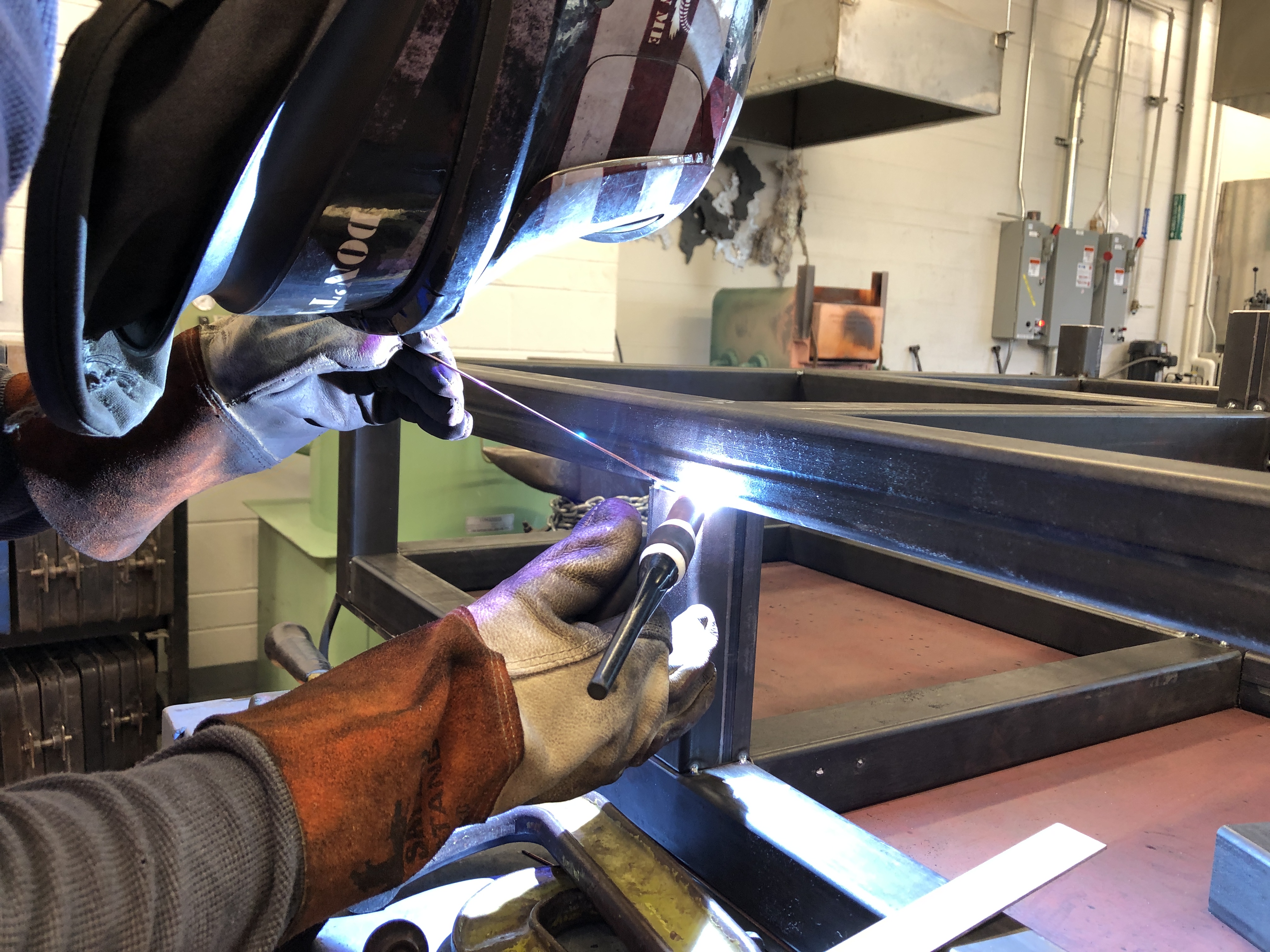
The base was fabricated by students — welded steel, height-adjustable, with swappable fascia. Beneath it, spreader plates we designed distribute her weight evenly across the floor, keeping the load inside its PSI limit. Nearly indestructible, and honestly a standard-bearer for how a statue stand should be built. (One or two of the welds are mine, just to have a hand in it.)
VIIIThe move
Within a bolt of taking the building apart.
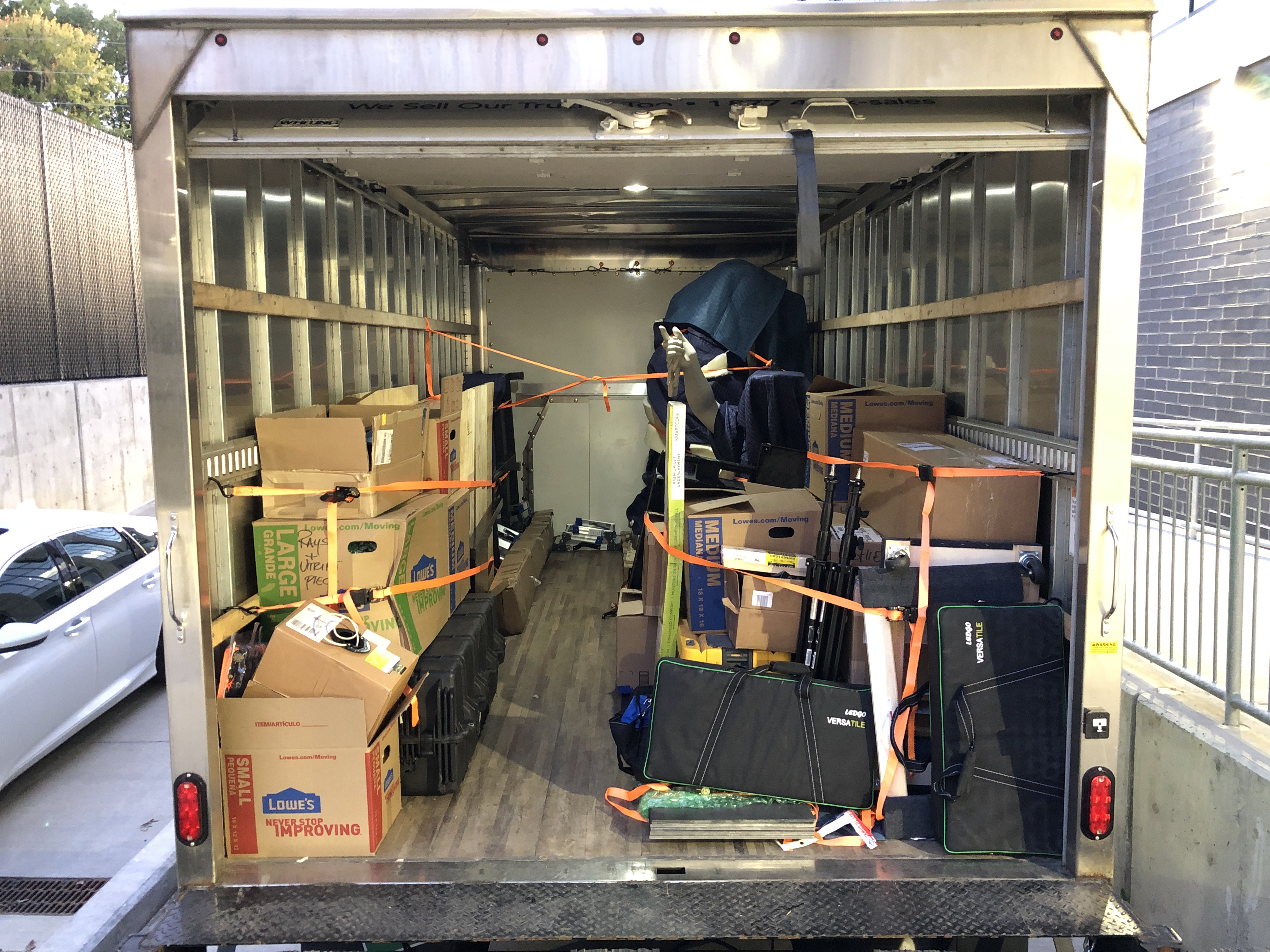
Ellis Island is run by the National Park Service, and Brent Talbot of the NPS staff supplied the exact clearances for the route from loading dock to gallery. She was printed in three sections so she could travel to New York and fit the building's small elevators and narrow corridors. Even so, the route was harrowing in places; at one point the team was inches from removing a piece of building trim to get her through.
She fit anyway — with precision, because every dimension had been checked, re-checked, and checked again before a single layer was ever printed. The margin was earned long before move-in day.
Getting her there was its own craft. Tammy Honesty and her team helped us pack, move, and ship her, then unpack and set her up — twice.
We came within a bolt of taking the building apart. She fit.
IXThe exhibit
Nobody argued about whether they were looking at the real thing.
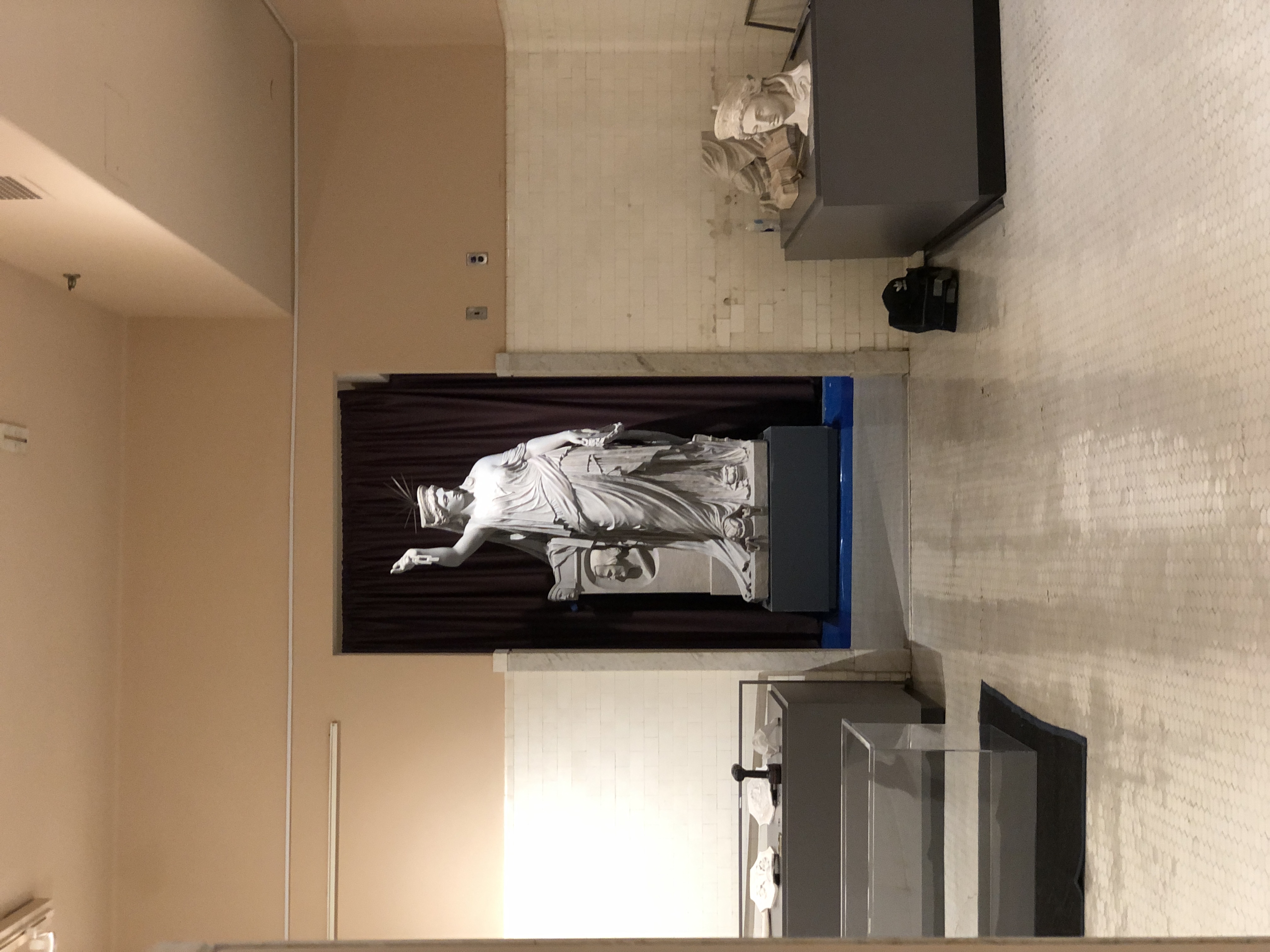
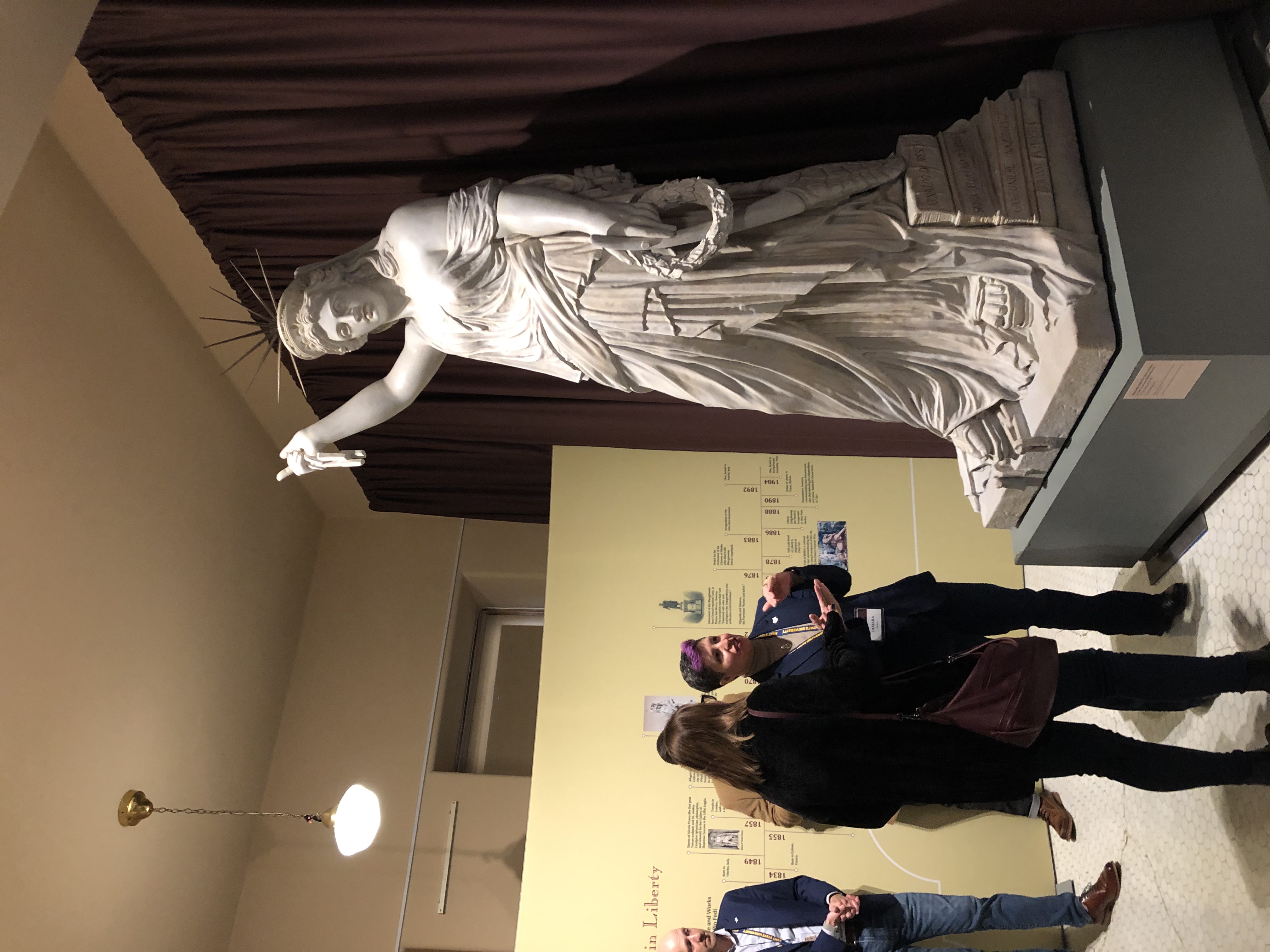
Sisters in Liberty: From Florence, Italy, to New York, New York opened at the Ellis Island National Museum of Immigration on October 17, 2019 — the first exhibition the Opera di Santa Croce had ever mounted outside Italy. Across the water from her sister on Liberty Island, she held the end of the hall exactly as modeled. Visitors who grew up going to church at Santa Croce said it was like standing in Florence again, and the quality of the figure itself was never in question.
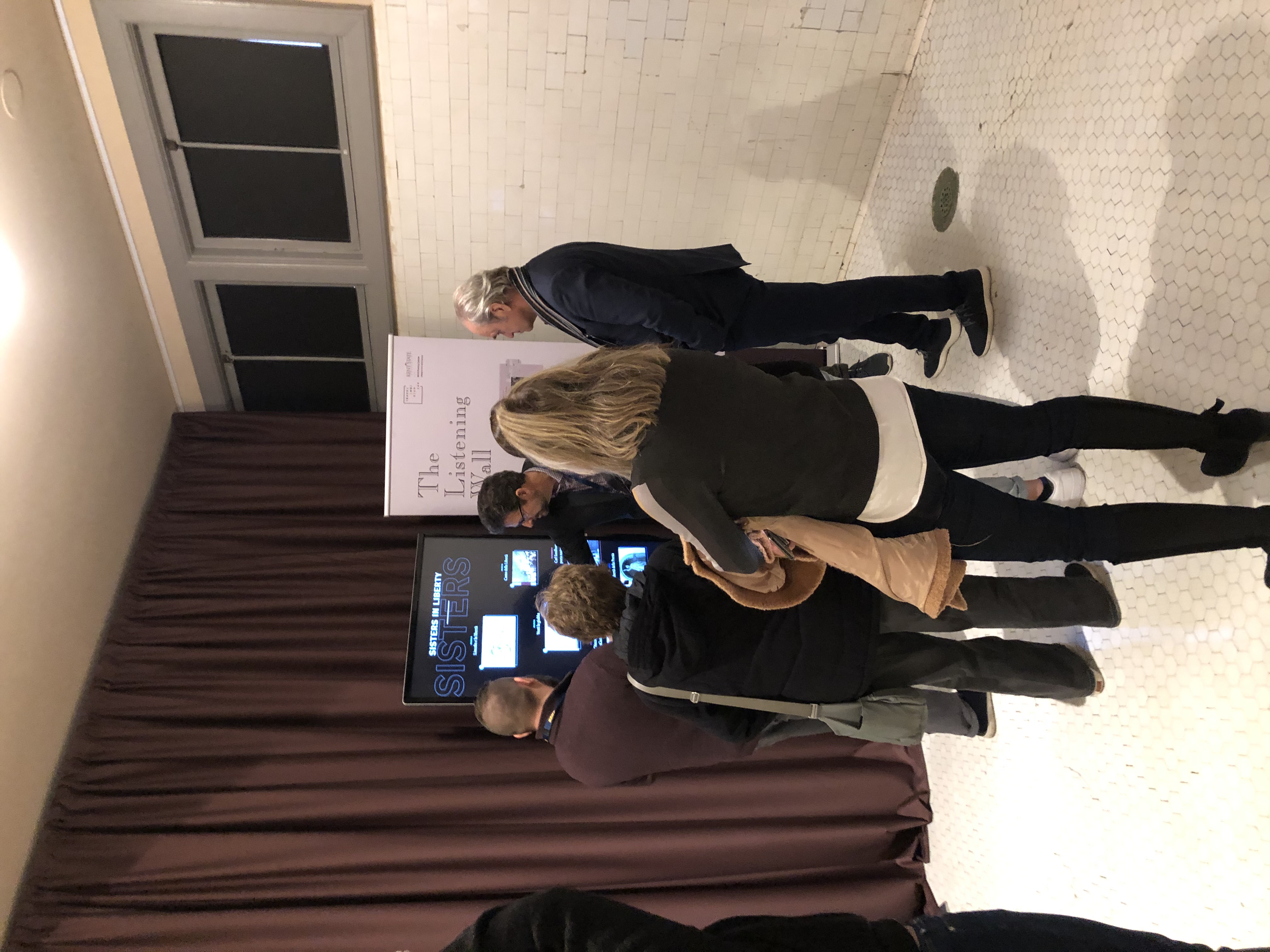
She didn't stand alone. Companion prints filled the cases, and a poetry experience from David Hassler and the Wick Poetry Center ran on kiosks designed by the marketing firm Each and Every, which I supported. The project also lived online on a site I built on AWS — WordPress on the Divi framework — with marketing design by Alyssa Mazey.
They were looking at the real thing — through the hands of everyone who cared to keep it.
Liberty of Poetry
After Pio Fedi, 1870–83. Basilica of Santa Croce, Florence.
- Scale
- 80%, printed in three sections
- Body
- Binder-jetted sand, primed and painted
- Crown
- Cast aluminum rays, painted to read as bronze
- Capture
- 100+ structured-light scans, on site
- Shown
- Ellis Island, 2019–2020
XAn end date
One of the biggest stories I had the opportunity to help tell — and then the doors closed.
The exhibit became one of the most visible stories I had the opportunity to help tell: coverage in Forbes and a nomination for Best International Exhibit. Then COVID closed everything; gathering around a statue was no longer possible.
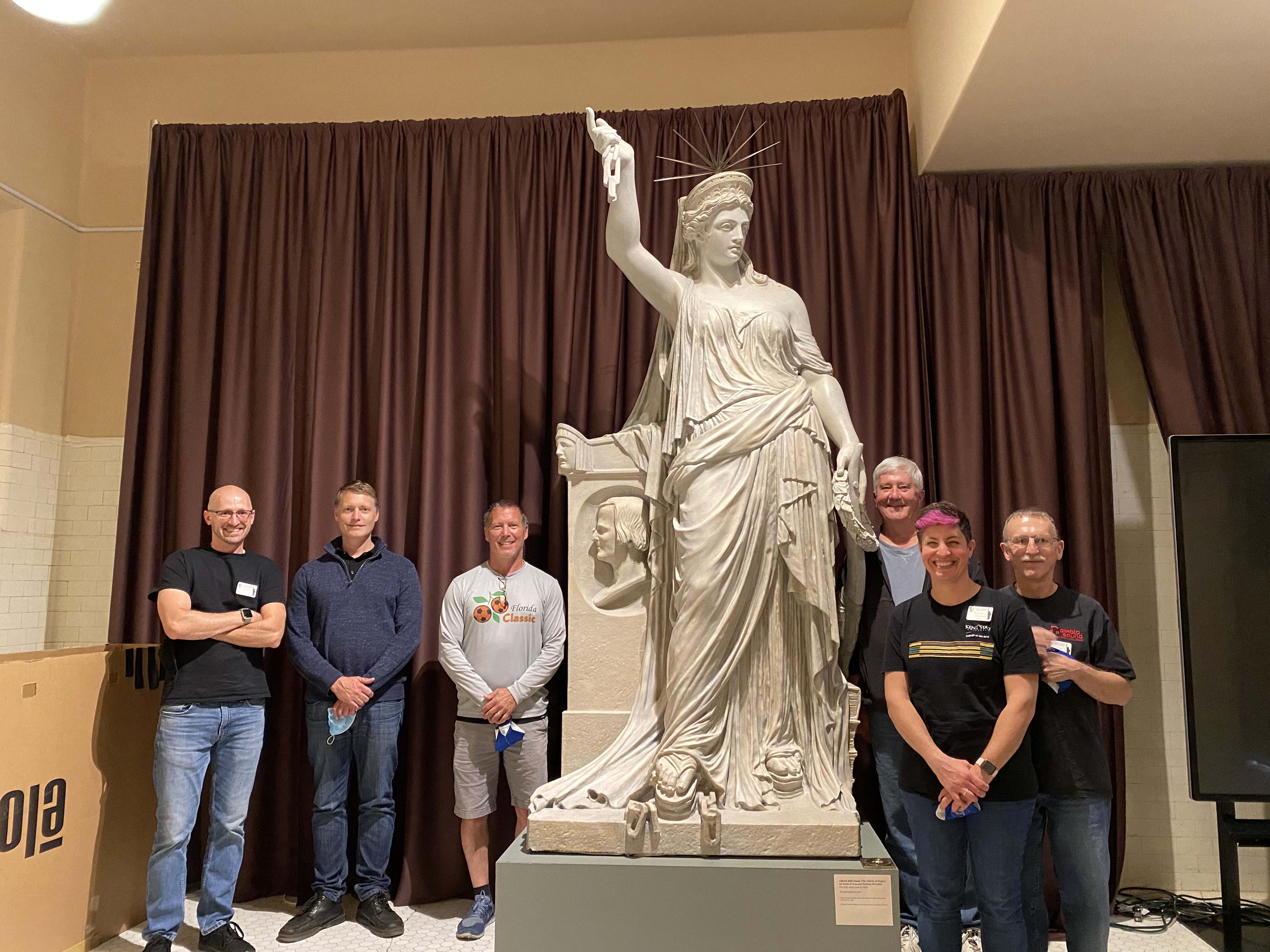
De-installation happened in masks. At the very end, Jim made everyone pull their masks off for a single photo. The project's conclusion came during a period when the world itself had changed. For me, what remained was the sense that the work had created something public and shared — something that had brought people together around a common idea.
Talk about liberty. Why did that have an end date?
Afterword
Why write the names down.
What I wanted was to make something that mattered — to use a university as the third space it's meant to be, a place where people gather around an idea worth gathering around. This is a record of that, told from the maker's side, with room for everyone else's telling alongside it.
Historians of science have a name for a gap like the one this page is trying to close. Steven Shapin called it the invisible technician: the skilled assistants whose hands made Robert Boyle's experiments work, and who almost never appear in the published account. The sociologist Howard Becker made the same point about art: every work is made by a whole network of people, and the convention is to credit one of them.
A museum label names the sculptor and the lender. It rarely names who held the scanner, who welded the rays, or who matched Carrara marble in paint. The credits below are my attempt to write those names down, mine included.
On the record
What was published at the time.
- Kent State MagazineHow the project began in Santa Croce, and who went to Florence to scan her.
- Kent State UniversityThe announcement of the partnership with the Opera di Santa Croce.
- ForbesJonathon Keats on comparing the two statues side by side at Ellis Island.
- 3DPrint.comFreshmade 3D on printing the nine-foot replica, and the sand-printed mold for the rays.
- News 5 ClevelandLocal coverage ahead of the opening.
- Rosco SpectrumThe painter's own account of matching the replica to the freshly cleaned original.
Credits
One telling, many hands.
Every person involved contributed something different, and each has their own story of this work. These descriptions come from my recollection of each person's role and are meant as acknowledgments, not complete biographies.
Original work
- Sculptor, Liberty of Poetry, 1870–83
- Pio Fedi
Partners
- Florence partner
- Opera di Santa Croce
- Exhibition venue
- Ellis Island National Museum of Immigration
- Printing
- Freshmade 3D / Humtown
Kent State
- Dean, College of Arts & Sciences; championed the project and its digital-humanities ambition
- James Blank
- Design Innovation Initiative; connected the Florence and Italian side of the collaboration
- J.R. Campbell
Capture and reconstruction
- 3D capture lead; scan alignment; crown rays in Fusion 360; sightline, scale, and weight studies; manufacturing evaluation; the project website; kiosk support
- Joshua Allen Talbott
- 3D imaging in Florence; research and critical support
- Rob Clements
- Critical support; operations and installation
- Antonio D'Angona
- Sculptor partner; statue canvas core; coordinated artistic subcontracting for mesh cleanup
- Rich Wetzel
- Consultations; 3D-printed statue and three Lady Italy busts; 3D-modeling subcontracting for mesh cleanup
- Christopher Tomko
- Exhibit cases, designed in Rhino
- Brendan Ho
Casting and metalwork
- Metal casting consulting and engineering
- Trent True
- Student fabricator; CAD mold design for the rays
- Michael Nelson
- Student fabricator; assistant casting technician
- Samantha Battaglia
- Student fabricator; welded the rays
- Jason Bogart
- Physics machinist; finishing and polishing of the cast rays
- Jay Onders
Finishing, move, and exhibit
- With her team: painting, test pieces, and finishing fixes; packing, shipping, and setup, twice
- Tammy Honesty
- National Park Service; clearances for the move-in
- Brent Talbot
- Wick Poetry Center; the poetry experience on the kiosks
- David Hassler
- Design of the poetry kiosks
- Each and Every
- Marketing and project identity
- Alyssa Mazey
- Photography
- Rami Daud
If you were part of Libertas and would like your own account of the work here, alongside mine, I'd be glad to add it.